The Dutch chemical labour market employed approximately 99,000 FTEs in 2025. After years of growth, employment declined slightly. Enrolment in several chemistry-related degree programmes also fell. At the same time, demand for chemistry-trained vocational professionals remains high, while employment in the pharmaceutical segment of the chemical sector continues to grow. These are among the findings of the 2026 update of ChemistryNL’s Education and Labour Market Monitor.
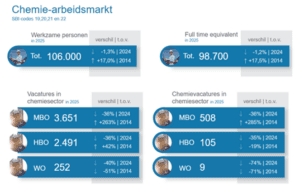
In 2025, the chemical labour market comprised approximately 99,000 FTEs. This marked the end of a long period of growth: compared with 2015, employment is still around 20% higher, but in 2025 it declined by 1.3%. Developments also vary considerably between subsectors. The pharmaceutical industry in particular has shown strong growth. Between 2015 and 2025, employment in this sector increased by 65%, reaching approximately 19,000 FTEs.
The manufacture of chemical products is the largest subsector, accounting for approximately 44,000 FTEs. The rubber and plastics industry is also substantial, with around 30,000 FTEs. Employment in both sectors has declined in recent years, but remains above the level of ten years ago.
The decrease in the total number of vacancies does not mean that labour market shortages have disappeared across the board. The number of registered vacancies fell by approximately 35 to 40% in 2025, both for chemistry-related and non-chemistry-related positions. However, demand for vocationally trained chemistry professionals remains considerable. The number of vacancies for positions such as process operators is still around three times higher than it was ten years ago.
This makes developments in enrolment in vocational chemistry education particularly relevant to the sector. It is precisely at the level where the labour market shows a strong need for skilled professionals that enrolment in the corresponding programmes has fallen sharply over the past ten years.
Developments in chemistry education
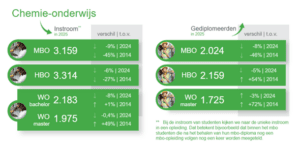
Enrolment in chemistry-related vocational, higher professional and university bachelor’s programmes fell by 6 to 9% in 2025. Compared with ten years ago, enrolment in vocational chemistry education is 45% lower, while enrolment in higher professional chemistry education has fallen by 27%. Enrolment in university bachelor’s programmes is approximately at the same level as ten years ago.
Enrolment in university master’s programmes remained stable in 2025 and is 49% higher than ten years ago. International students play an important role in this. In 2025, they accounted for approximately 20% of enrolment in higher chemistry education, representing around 1,500 students. It is estimated that 30 to 40% of international chemistry graduates are still working for a Dutch company five years after graduation.